
Animals Building Life
Forgive the past, take responsability and move forward.
Perdonare il passato, assumersi responsabilità e andare avanti.
Equine Ethics Inquiring Human Coaching
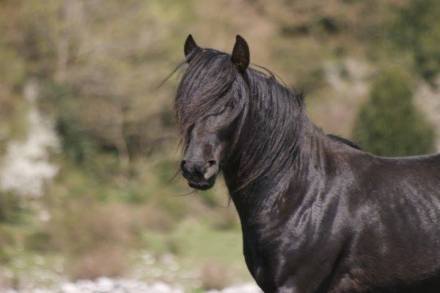 In the wake of the last twenty years of fashions for the so-called natural horsemanship, are also arisen a whole series of coaching schools that use horses to develop leadership and self-leadership skills in humans.
Besides being ethologically and ethically questionable precisely the concept of leadership and self-leadership, also for human animals, these approaches use the horse as a myth, as a teacher, as a prey, as a mirror, a zen-like guide, as clairvoyant, as an angel fallen on earth to save us, through various other anthropomorphic projections, which too often are always resolved and still fall in training situations, misunderstanding species-specific characteristics of identity, subjectivity and socio-cognitive dimensions of horses, violating their right to be recognized as horses with their own world of perception.
The referential contribution that equines and other animals can give to human animals, passes and can pass only through the recognition of the identity character of the horse, through the knowledge and the effective respect, not just stated, of reciprocity, subjectivity and otherness, inside an cognitive-constructivist and antispeciesist framework of reciprocal interaction, learning and growth.
In the pic by José De Giorgio a free-roaming Esperia stallion on the central mountains of Italy.
La scienza non prova, esplora.
Sono cresciuto a pane e scienza, sin da piccolo infatti ero affascinato dalle materie scientifiche, molto più che da quelle umanistiche, con un particolare interesse verso il campo delle discipline bio-naturalistiche. Da bambino ero noto, tra amici e parenti, per conoscere anche le specie animali più rare. Ricordo che spesso a casa, quando ricevevamo ospiti, si imbandivano vere e proprie prove di conoscenza animale. Alle scuole medie, insieme ad altri compagni di classe, ricordo che portai una ricerca sui grandi felini: ognuno di noi scelse una specie ed io scelsi l’Irbis, il leopardo delle nevi. Ancora ricordo l’espressione del professore di scienze, che non conosceva affatto questa specie, rimanendo affascinato a sentirmi raccontare le abitudini di quel raro felino. In seguito raggiunta l’adolescenza studiai i maggiori libri dell’epoca sul comportamento animale che poi sarebbero stati miei testi all’esame di etologia all’Università di Parma che diedi nei primi anni 80, una disciplina che i veterinari e gli istruttori cinofilo-equestri avrebbero scoperto, spesso misinterpretandola e sporcandola di behaviorismo, solo vent’anni più tardi, con l’etologia applicata.
Quindi la scienza sempre come mia bussola principale, fatta di tanta etica, tanta esplorazione, di poche evidenze fini a se stesse e di poche speculazioni antropocentriche. Oggi però la scienza rappresenta sempre più un altro tipo di religione, il cui libro sacro è quello della statistica ed i cui fondamentalisti appartengono alle congregazioni monastiche dell’industria delle pubblicazioni scientifiche, dove ricercatori più o meno esperti e giovani studenti si piegano ai precetti del metodo scientifico o presunto tale, recitando le loro preghiere statistiche quotidiane, perdendo di vista i soggetti-di-una-vita che loro dicono di voler studiare, tenendo scarsamente, se non per nulla, conto di moderni principii di etica animale, con materie come l’etologia asservite allo sfruttamento e all’addestramento animale, più che alla conoscenza dell’animale quale portatore di un suo valore intrinseco e soggettivo, oltre che costruttore di una sua propria tradizione culturale individuale e di gruppo.
Oggi il mio contributo, anche in seno ai contesti scientifici, accademici e per gli studenti che affianco nei loro percorsi di tesi, non può essere altro che quello di consegnare e riconsegnare il primato all’etica, all’esplorazione, alla meraviglia, per una scienza secolare, infedele e post-umanista.
La scienza non prova, esplora. – Gregory Bateson
Joint attention, a moral attitude.
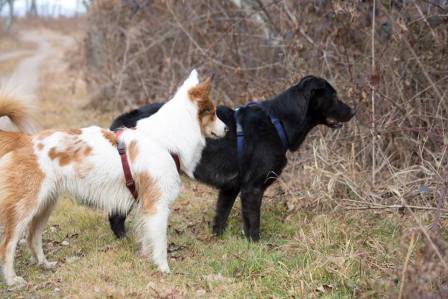
Joint attention is the socio-cognitive ability, of two or more social animals, living in the same socio-familiar group, to share attention towards something, some situation or someone, as in this photo in which Pan and Idea join their shared attention towards something other, and this can be defined as a social disposition.
For some authors that deal with ethical questions, this kind of social behavior is connected with the evolutionary question about morality, because joint attention presumes the capacity to share the perspective of another and this falls in the cognitive innate foundations for moral reasoning.
Of course this can happen only in presence of a familiar context with strong bonds and is not present between animals unfamiliar to each other. So ethics for animals is a social theme, not inherent to socialization classes for animals, because those last ones can not be defined as really social contexts.
In the pic by Mattia Marinolli, Pan and Idea, living with Irene Buttà (Learning Animals student), are joining their attention.
 Francesco De Giorgio
Devi effettuare l'accesso per postare un commento.